
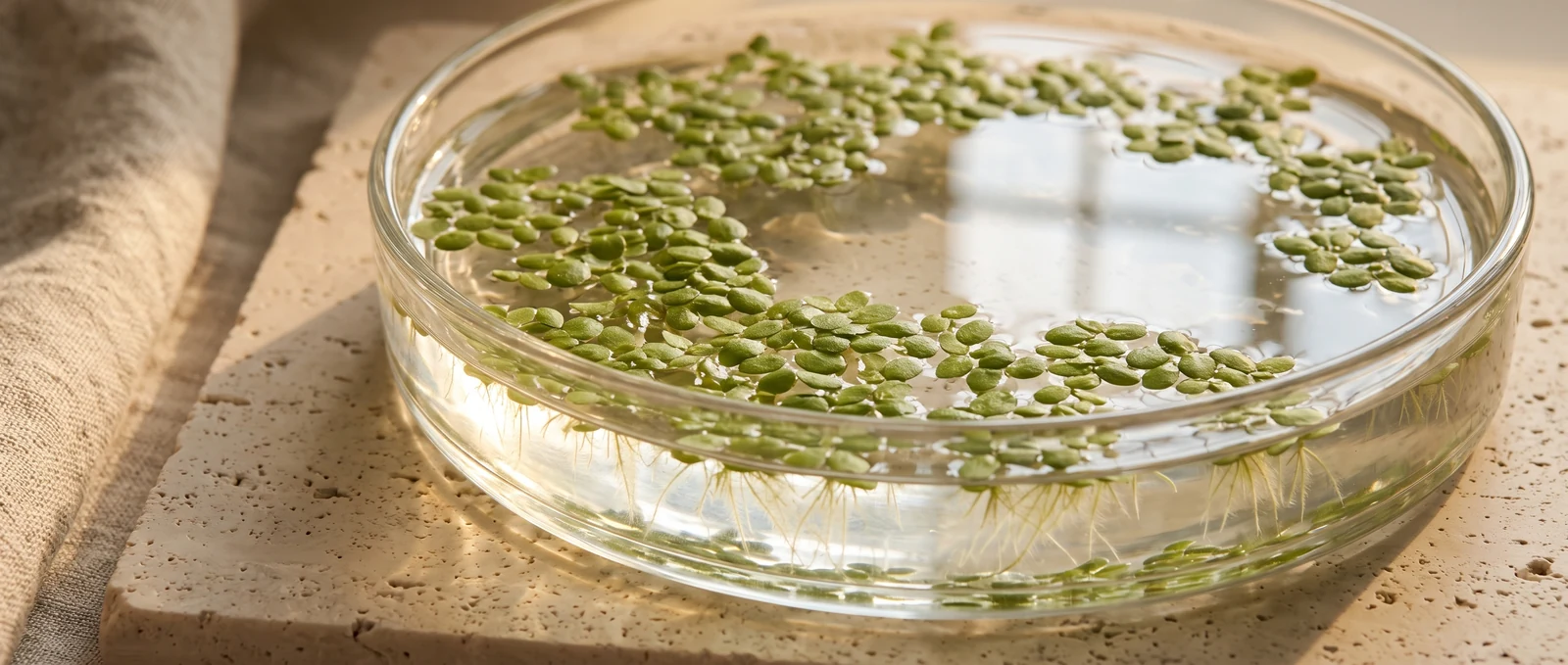
Let's start with a quiz
What's the most abundant protein on the planet?
If you guessed whey, collagen, or anything else with its own shelf at the gym, that's a reasonable guess and it's wrong. The answer is a protein called rubisco, and you are almost certainly within ten feet of some right now. It's in the basil on your windowsill. It's in the tree outside. It's in every green leaf of every plant on Earth.
I make a protein powder for a living, so I've spent an unreasonable amount of time reading about this, and I still find it a bit ridiculous. The single most common protein in the world, and until very recently you couldn't buy a tub of it.
So I want to walk you through why. It's a good story, it involves cows and a plant that doubles in size over a long weekend, and by the end you'll know more about protein than most of the people selling it to you.
Meet rubisco, the busiest protein you've never heard of
Think of a leaf as a tiny solar-powered kitchen. Sunlight is the stove. Air and water are the ingredients. The meal is sugar, which the plant uses to build everything else.
Rubisco is the cook who grabs carbon dioxide out of the air and gets it into the pot. Every plant needs that job done constantly, and here's the funny part: rubisco is slow. Averaged across the world's land plants, each one does its single job about twice a minute.[1]
Plants solve that the way a restaurant would. They hire a lot of cooks.
How many? In 2019, two scientists tried to weigh all the rubisco on Earth. Their answer was about 0.7 gigatonnes, which was more than ten times the previous estimate.[1] A gigatonne is a billion tonnes, a number too big to mean anything, so here's the same figure another way: it works out to more than 80 kilograms of rubisco for every person alive.
And it's good protein. A 2023 review in the Journal of Experimental Botany describes purified rubisco as "easily digestible" and "nutritionally complete," with qualities "on a par with those of many animal proteins."[2]
So. Abundant, complete, growing on every continent for free. Which raises a fair question.
Why isn't this in everything? (The salad problem)
Because a leaf is a terrible place to keep protein if you want to get it out again.
The same review lists the problems, and they stack up fast.[2]
- Leaves are mostly not protein. Rubisco makes up only about 3% of a leaf's weight.[1] Seeds pack protein far more densely, which is why we farm peas and soybeans and nobody farms lettuce for its macros.
- Leaves go off quickly. Pick them and the clock starts.
- The protein is locked inside. You have to break open the cell walls to reach it.
- Everything comes out green. The protein has to be separated from chlorophyll, the pigment that makes a leaf look and taste like a leaf.
Put plainly, you'd have to eat a heroic amount of salad. Nobody is getting 20 grams of protein from spinach without a very long lunch.
Humans did find a workaround, a long time ago. We let an animal eat the leaves for us. A cow is, among other things, a walking machine for turning grass into protein we can use. It works. It's also a pretty roundabout way to do it: a global study of 38,000 farms found that 100 grams of protein from a beef herd takes about 164 square metres of land, against roughly 3.4 for peas.[3]
So for a long time the choice has been seeds or animals. Leaf protein, the biggest supply of all, stayed in the leaf.
Enter a plant that is basically all leaf
Now picture the ideal plant for this job. You'd want one with no trunk, no stalk and no branches, because those are all effort spent on things you can't eat. You'd want it to grow absurdly fast. And ideally you could harvest it without digging anything up.
That plant exists. It's called Lemna, and it floats.
Each Lemna plant is one small green leaf, a few millimetres wide, sitting on the surface of still water with a little root dangling underneath.[16] That's the whole plant. It belongs to a family of 36 species[4] that you may know by its less glamorous name, duckweed. Botanists describe the family as "some of the smallest and fastest growing angiosperms known on Earth."[5] (Angiosperm means flowering plant. Yes, they flower. Bring a magnifying glass.)
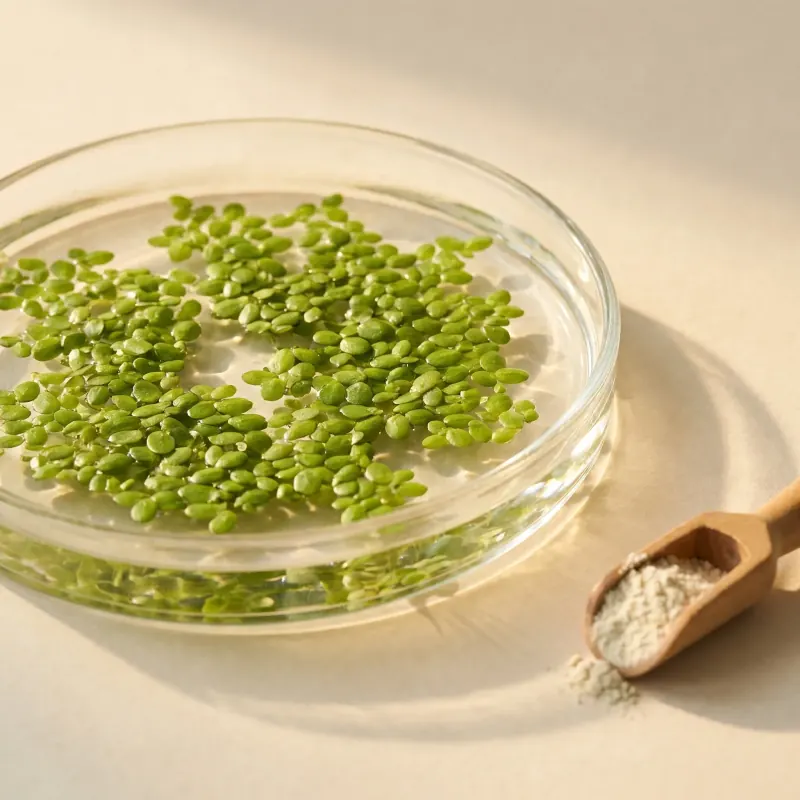
About that speed. In 2015, researchers grew 39 different strains side by side and timed how long each took to double. The fastest did it in 32 hours.[6]
Doubling is one of those things our brains are bad at, so let's do the maths. Say you start with enough to cover a postage stamp on Monday morning. By the next Monday you've got more than thirty stamps' worth. A field of peas spends that week getting very slightly taller.
None of this is new to everyone. In northern Thailand, Laos and Myanmar, a close cousin of Lemna has been eaten as a vegetable for generations. It's called khai-nam, "eggs of the water," and two researchers wrote it up in Nature back in 1971 as a promising cheap source of protein.[7] It has also caught the eye of space researchers, who need crops that grow fast in very little room.[8]
The dried plants in this family are 20% to 35% protein.[9] That's the leaf protein we've been talking about, in a plant that's finally practical to get it out of.
Okay, but is it good protein?
Here's what we can say with a straight face.
Your body needs nine amino acids it can't make itself, called the essential amino acids. A protein that supplies all nine is called complete. Plants in the Lemna family contain all nine, in a pattern researchers call "close to the WHO recommendations."[9]
We've also worked out the numbers for our own powder, using the amino acid profiles of the two proteins that go into it. Per gram of protein, all nine essential amino acids come in above the adult reference pattern set by the WHO and FAO. The lowest of the nine still lands at 140% of the reference.[10] A lab analysis of the finished powder is under way, and I'll update these figures when it's back.
The fine print (because you'd ask)
What's in a scoop and what reaches your bloodstream are two different questions. The second one takes human trials, and the published ones for Lemna are few.
In one, twelve adults ate a soup made from whole dried Lemna, and on another day a pea soup with the same amount of protein. Their blood amino acids rose less after the Lemna. The researchers put that down to things you'd expect in a whole plant, like fibre and tough cell walls.[11] In another, a Lemna protein concentrate delivered about 60% to 66% of what whey did, with a huge spread from person to person.[12]
Those studies tested a whole plant and a mid-strength concentrate. A purified protein is a different food, so I wouldn't read those numbers across to it. As more digestion data on the purified protein becomes public, I'll add it to this post.
I'd rather show you the unflattering studies than have you find them yourself and wonder why I didn't.
Who checked that it's safe?
Food regulators, on both sides of the Atlantic.
In the US, the FDA has reviewed two safety filings for ingredients made from these plants, one in 2018 and one that closed in February 2026 for an ingredient listed as "Lemna leaf protein." Both times the agency's answer was that it had no questions.[13][14] In Europe, the food safety authority reviewed a Lemna protein concentrate in 2023 and concluded it "is safe under the proposed conditions of use."[15]
(A small aside for the detail-lovers. In that 2018 letter, the FDA stopped mid-review to correct the company's botany in a footnote. A government food-safety letter with opinions on plant taxonomy. I love it.)
The planet part, minus the hype
This is where a lot of brands would tell you the plant will save the world. I'd like to be more careful than that, so here are the parts I'm confident about.
Lemna doesn't need farmland, because it grows on water, in shallow ponds or tanks. It grows fast enough to harvest over and over instead of once a season. And nearly the whole plant is the useful part.
And here's what I can't give you yet: a solid, independent number for its footprint as a food protein. The figures in the research swing widely depending on how and where it's grown, and I'm not going to pick the flattering one. A plant earns the word "sustainable" with data, and that data is still coming in.
What I can say is that this feels early, in the good way. For most of history the options were seeds or animals. A third option is turning up, and we get to be part of the first chapter.
So where do we come in?
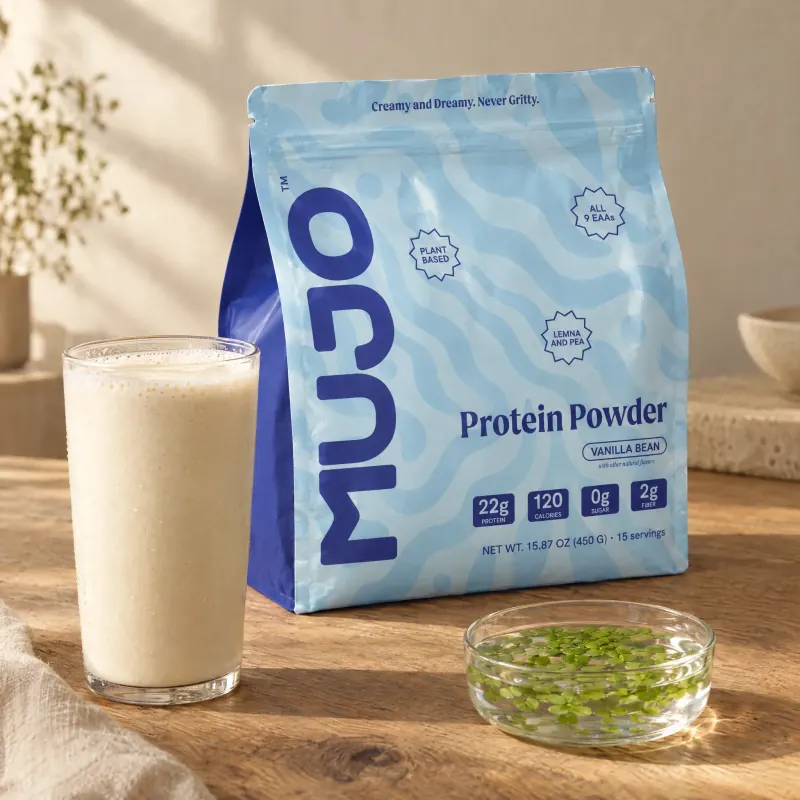
Mujo Protein Powder is made with Lemna leaf protein and yellow pea protein. It has 22 grams of protein a serving and all nine essential amino acids, and it's vanilla. Here's the full story on it.
Next time: the word "complete" is doing a lot of work
I've used the phrase "all nine essential amino acids" several times now, and I owe you an explanation of what it does and doesn't mean. Because here's a strange fact to leave you with: a food can say "10g protein" on the front, be made of real protein, and still score zero on the main scale scientists use to rate protein quality.
That's part two.
FAQ
What is Lemna protein? Protein taken from the leaves of Lemna, a tiny floating plant. Dried plants in this family are 20% to 35% protein by weight.[9]
Is Lemna the same as duckweed? Yes. Duckweed is the everyday English name for the plant family, and Lemna is one of its five groups.[4]
Is Lemna protein a complete protein? Plants in this family contain all nine essential amino acids, in a pattern researchers describe as close to WHO recommendations.[9]
Is it safe to eat? The FDA has reviewed safety filings for ingredients made from it and had no questions, and Europe's food safety authority has concluded a Lemna protein concentrate is safe for its proposed uses.[13][14][15]
What is rubisco? The protein in green leaves that captures carbon dioxide during photosynthesis. It's widely described as the most abundant protein on Earth.[1][2]
Sources
- Bar-On YM, Milo R. The global mass and average rate of rubisco. PNAS. 2019;116(10):4738-4743. https://doi.org/10.1073/pnas.1816654116
- Pearce FG, Brunke JE. Is now the time for a Rubiscuit or Ruburger? Increased interest in Rubisco as a food protein. Journal of Experimental Botany. 2023;74(2):627-637. https://doi.org/10.1093/jxb/erac414
- Poore J, Nemecek T. Reducing food's environmental impacts through producers and consumers. Science. 2018;360(6392):987-992. https://doi.org/10.1126/science.aaq0216 Land use per 100g protein, via Our World in Data: https://ourworldindata.org/grapher/land-use-protein-poore
- Bog M, Appenroth KJ, Sree KS. Duckweed (Lemnaceae): its molecular taxonomy. Frontiers in Sustainable Food Systems. 2019;3:117. https://doi.org/10.3389/fsufs.2019.00117
- Acosta K, Appenroth KJ, Borisjuk L, et al. Return of the Lemnaceae: duckweed as a model plant system in the genomics and postgenomics era. The Plant Cell. 2021;33(10):3207-3234. https://doi.org/10.1093/plcell/koab189
- Ziegler P, et al. Relative in vitro growth rates of duckweeds (Lemnaceae): the most rapidly growing higher plants. Plant Biology. 2015;17(s1):33-41. https://doi.org/10.1111/plb.12184
- Bhanthumnavin K, McGarry MG. Wolffia arrhiza as a possible source of inexpensive protein. Nature. 1971;232:495. https://www.nature.com/articles/232495a0
- Romano LE, Aronne G. The world smallest plants (Wolffia sp.) as potential species for bioregenerative life support systems in space. Plants. 2021;10(9):1896. https://doi.org/10.3390/plants10091896
- Appenroth KJ, Sree KS, Böhm V, et al. Nutritional value of duckweeds (Lemnaceae) as human food. Food Chemistry. 2017;217:266-273. https://doi.org/10.1016/j.foodchem.2016.08.116
- WHO/FAO/UNU. Protein and amino acid requirements in human nutrition. WHO Technical Report Series 935. 2007. Mujo Protein Powder figures are calculated from the amino acid profiles of the two proteins in the blend; a lab analysis of the finished powder is in progress.
- Zeinstra GG, et al. Postprandial amino acid, glucose and insulin responses among healthy adults after a single intake of Lemna minor in comparison with green peas: a randomised trial. Journal of Nutritional Science. 2019;8:e28. https://doi.org/10.1017/jns.2019.26
- Mes JJ, et al. A controlled human intervention trial to study protein quality by amino acid uptake kinetics with the novel Lemna protein concentrate as case study. International Journal of Food Sciences and Nutrition. 2022;73(2):251-262 (online 2021). https://doi.org/10.1080/09637486.2021.1960958
- US Food and Drug Administration. Response letter, GRAS Notice No. GRN 000742. 22 August 2018. https://www.fda.gov/media/116248/download
- US Food and Drug Administration. GRAS Notice Inventory, GRN No. 1256 (closed 5 February 2026). https://www.fda.gov/food/generally-recognized-safe-gras/gras-notice-inventory
- EFSA Panel on Nutrition, Novel Foods and Food Allergens. Safety of water lentil protein concentrate from a mixture of Lemna gibba and Lemna minor as a novel food. EFSA Journal. 2023;21(4):e07903. https://doi.org/10.2903/j.efsa.2023.7903
- Flora of North America. Lemna (genus description: fronds 1 to 8 mm, one root per frond). https://floranorthamerica.org/Lemna