
Last time I left you with a strange fact: a food can say "10g protein" on the front, be made of real protein, and still score zero on the main scale used to rate protein quality.
Both of those things are true at once, and working out how is the fastest way I know to understand protein. So let's do it.
Protein is a word. Amino acids are the letters.
Your body doesn't use the protein you eat as it arrives. It takes it apart first.
Every protein, whether it comes from a steak, a chickpea or a leaf, is a long chain built from smaller pieces called amino acids. There are 20 of them. Think of them as an alphabet with 20 letters. Digestion breaks the chain back down into loose letters, and your body then uses those letters to spell out whatever it needs: muscle, enzymes, hormones, the lining of your gut, your hair.
Here's the part that matters. Your body can make 11 of those letters itself, from spare parts. The other nine it can't make at all. Those nine have to come from food, every day, and they're called the essential amino acids.[1]
For the record, the nine are histidine, isoleucine, leucine, lysine, methionine, phenylalanine, threonine, tryptophan and valine. There won't be a test.
The leaky barrel
Now imagine you're spelling words with letter tiles, and you've got a huge pile of every letter except one. You have three of the letter E.
It doesn't matter how many of the others you're holding. Once the three E's are gone, you're stuck, and the rest of the pile sits there unused.
Protein works the same way, and nutrition has had a picture for this for a very long time. Imagine a wooden barrel where each plank is a different height. You can only fill it to the top of the shortest plank. Everything above that pours out the side.
Each plank is one essential amino acid. The shortest one has a name: the limiting amino acid. It sets the ceiling for how much of that protein your body can put to work building things.[2]
So "complete protein" has a fairly plain meaning. It's a protein with all nine planks present and tall enough.
So how does a protein score zero?
Take collagen. It's a real protein, and it's everywhere right now: in powders, coffee creamers, gummies, bars.
Collagen is missing one of the nine essential amino acids entirely. It has no tryptophan.[3]
Go back to the barrel. In collagen's barrel the tryptophan plank is missing altogether, and a barrel with a missing plank holds nothing, however tall the other eight are.
That's the zero. The standard scoring method takes the shortest plank, compares it with what humans need, and uses that as the score.[2] No tryptophan means the score is zero, even though the tub contains ten real grams of protein by weight.
To be fair to collagen, people take it for reasons that have nothing to do with hitting a protein target, and this says nothing about those. It only means that "10g protein" on a collagen product and "10g protein" on a carton of eggs are describing two very different things.
Who decides the score?
The scoring method has a name only a committee could love: PDCAAS, the protein digestibility-corrected amino acid score. It does two things.[2]
- It finds the shortest plank and compares it with a reference pattern of what humans need.
- It multiplies that by how digestible the protein is, because amino acids you don't absorb don't count.
The result is a number from 0 to 1. Anything that comes out above 1 gets cut off at 1, so the best proteins all tie for first place.[2]
That cut-off is one of the method's known flaws. Scientists have pointed out others, including that it measures digestion at the wrong end of the gut, which flatters some proteins.[2] In 2013 the UN's Food and Agriculture Organization recommended replacing it with a newer score called DIAAS, which measures absorption earlier, at the end of the small intestine, and doesn't cap the top.[4] DIAAS is the better ruler. PDCAAS is still the one written into US labelling law.
The label trick almost nobody knows
This is the most useful thing in this post, so here it is in bold: the grams of protein on a US label are not adjusted for quality. The % Daily Value is.
The gram number is a measure of weight. The % Daily Value next to it has to be corrected using PDCAAS. And the rules say that percentage must be shown whenever a product makes a protein claim. If the score is very low, the label has to either show the corrected percentage or carry the words "not a significant source of protein."[5]
The Daily Value for protein is 50 grams. So a serving with 10 grams of top-scoring protein should show 20%. If the same 10 grams shows 8%, the label is quietly telling you about the planks. A pure collagen product would show 0%.
Next time you're in a shop, turn something over and look for it. It's a small thrill.
Are plant proteins worse?
This is where it's easy to say something sloppy, so I'll stick to what was measured.
In 2018, researchers analysed a long list of protein isolates, plant and animal, in the same lab with the same method. They looked at how much of each protein was made of essential amino acids.[6]
Whey came in at 43% and egg at 32%. Wheat, oat and lupin sat around 21% to 22%. Two essential amino acids in particular, lysine and methionine, were typically lower in the plant proteins.
That's the honest basis for the idea that plant protein is "lower quality." But the same paper makes a second point that gets left out: the plant proteins were very different from each other.[6] "Plant protein" covers everything from wheat to soy to potato, and lumping them together is a bit like reviewing "restaurants."
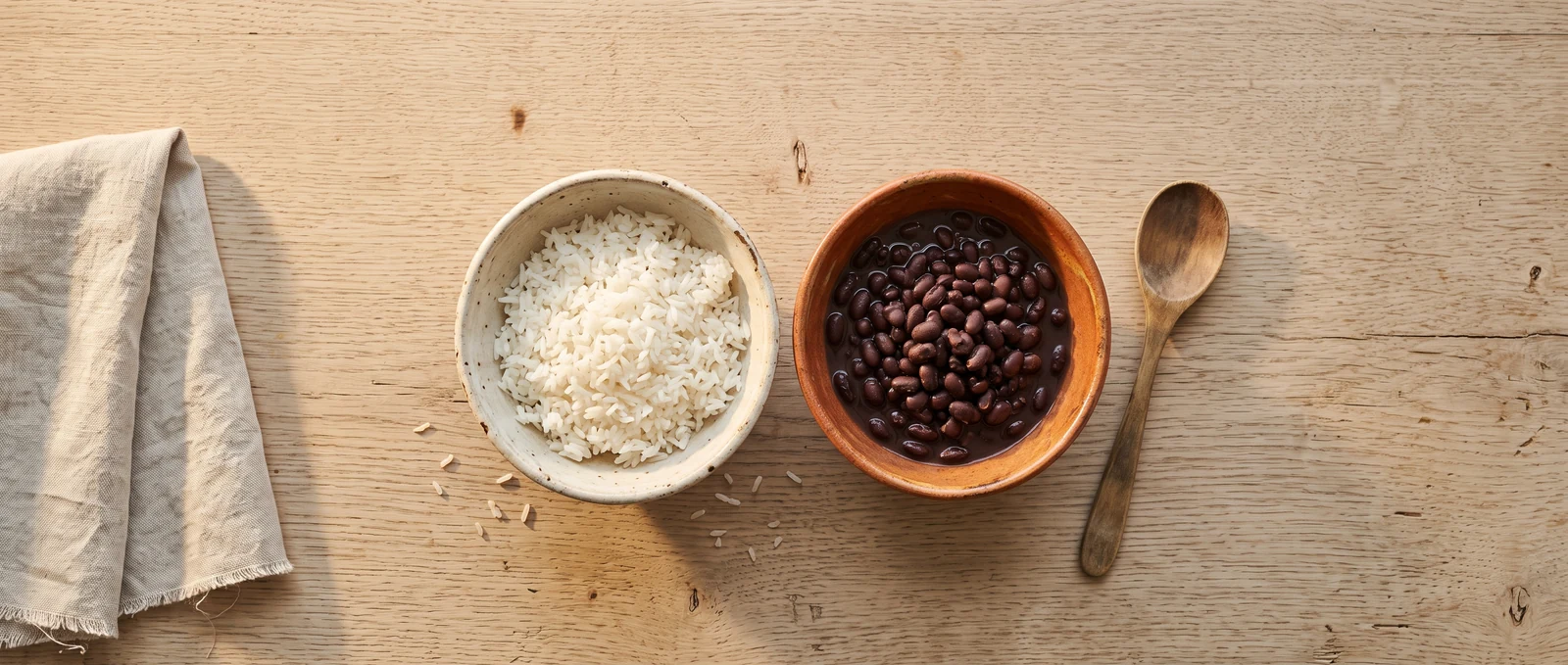
There's also good news if you eat a mix of things. A classic review in the American Journal of Clinical Nutrition put it this way: "Mixtures of plant proteins can serve as a complete and well-balanced source of amino acids."[7] One food's short plank is another food's tall one, which is the logic behind rice and beans, and behind most of the world's traditional cooking. You don't need to engineer this at every meal. The US Academy of Nutrition and Dietetics' position is that a variety of plant foods across the day does the job.[8]
Where our powder sits
Since I've just taught you to be suspicious, here are our numbers.
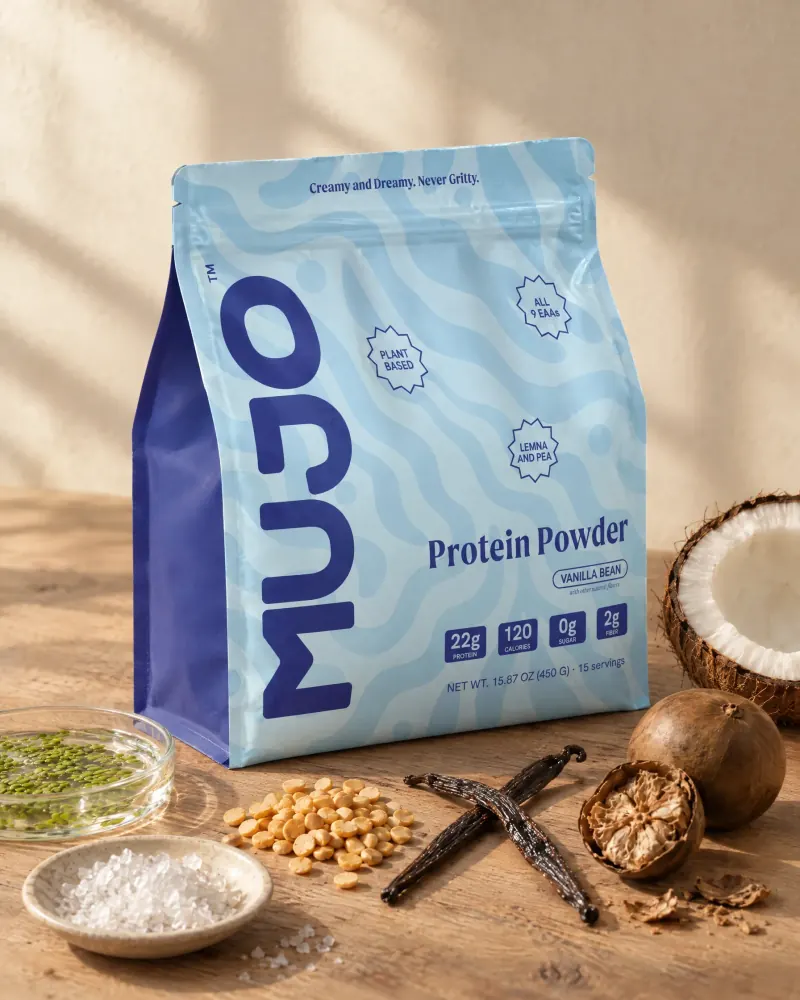
We worked out the figures for Mujo Protein Powder from the amino acid profiles of the two proteins that go into it, then compared each of the nine essential amino acids with the adult reference pattern from the WHO and FAO. On those figures, every one of the nine comes in above the reference. The shortest plank, methionine plus cysteine, sits at 140% of it.[1]
Two caveats, because you now know enough to ask for them. These are calculated figures; a lab analysis of the finished powder is under way, and I'll update the chart when it's back. And this is the amino acid half of the score, which isn't adjusted for digestibility. I went through the published digestion research in part one.
Next time: the number everybody argues about
So now you can judge how good a protein is. That leaves the question the whole protein aisle is built on: how much of it do you need?
Seven in ten Americans say they're actively trying to get protein into their day. Eight in ten can't say how much they're supposed to be eating. And the official answer comes from experiments in which scientists carefully measured everything that went into a group of volunteers and, I'm sorry to say, everything that came out.
That's part three, coming soon.
FAQ
What is a complete protein? A protein that supplies all nine essential amino acids, the ones your body can't make, in adequate amounts.[1][2]
Is collagen a complete protein? No. Collagen contains no tryptophan, one of the nine essential amino acids, so under the standard scoring method it's classed as incomplete.[3]
What's the difference between PDCAAS and DIAAS? Both score protein quality from amino acids and digestibility. PDCAAS caps scores at 1 and is the method used for US labels. DIAAS, recommended by the FAO in 2013, measures absorption at the end of the small intestine and doesn't cap the score.[2][4]
Do I need to combine plant proteins at every meal? No. Eating a variety of plant foods over the day supplies the full set of essential amino acids.[7][8]
Sources
- WHO/FAO/UNU. Protein and amino acid requirements in human nutrition. WHO Technical Report Series 935. 2007. Mujo Protein Powder figures are calculated from the amino acid profiles of the two proteins in the blend; a lab analysis of the finished powder is in progress.
- Schaafsma G. Advantages and limitations of the protein digestibility-corrected amino acid score (PDCAAS) as a method for evaluating protein quality in human diets. British Journal of Nutrition. 2012;108(S2):S333-S336. https://doi.org/10.1017/S0007114512002541
- Paul C, Leser S, Oesser S. Significant amounts of functional collagen peptides can be incorporated in the diet while maintaining indispensable amino acid balance. Nutrients. 2019;11(5):1079. https://doi.org/10.3390/nu11051079
- Rutherfurd SM, Fanning AC, Miller BJ, Moughan PJ. Protein digestibility-corrected amino acid scores and digestible indispensable amino acid scores differentially describe protein quality in growing male rats. The Journal of Nutrition. 2015;145(2):372-379. https://doi.org/10.3945/jn.114.195438
- US Code of Federal Regulations, Title 21, §101.9(c)(7), Nutrition labeling of food: protein. https://www.ecfr.gov/current/title-21/chapter-I/subchapter-B/part-101/subpart-A/section-101.9
- Gorissen SHM, Crombag JJR, Senden JMG, et al. Protein content and amino acid composition of commercially available plant-based protein isolates. Amino Acids. 2018;50:1685-1695. https://doi.org/10.1007/s00726-018-2640-5
- Young VR, Pellett PL. Plant proteins in relation to human protein and amino acid nutrition. The American Journal of Clinical Nutrition. 1994;59(5):1203S-1212S. https://doi.org/10.1093/ajcn/59.5.1203S
- Melina V, Craig W, Levin S. Position of the Academy of Nutrition and Dietetics: vegetarian diets. Journal of the Academy of Nutrition and Dietetics. 2016;116(12):1970-1980. https://doi.org/10.1016/j.jand.2016.09.025